

A Few Days in Beaune, Bourgogne (Burgundy)
There is so much to do in Burgundy, and so very little time. It is absolutely worthwhile to base yourself here rather than attempt it as a day trip from elsewhere. But with so many lovely hotels scattered across the peripheral countryside, choosing where to stay may be your most delightful dilemma.
If you are an oenophile, the drive alone is intoxicating. Passing village signs bearing names like Chassagne-Montrachet, Vosne-Romanée, Puligny-Montrachet, Pommard, Meursault, and Volnay, you may find yourself sorely tempted to simply settle into a magnificent 17th-century château carved from blocks of local limestone — and happily sip Pinot Noir fit for the gods while watching the world drift past the vines.
Resist, at least for a day, and give yourself to Beaune.
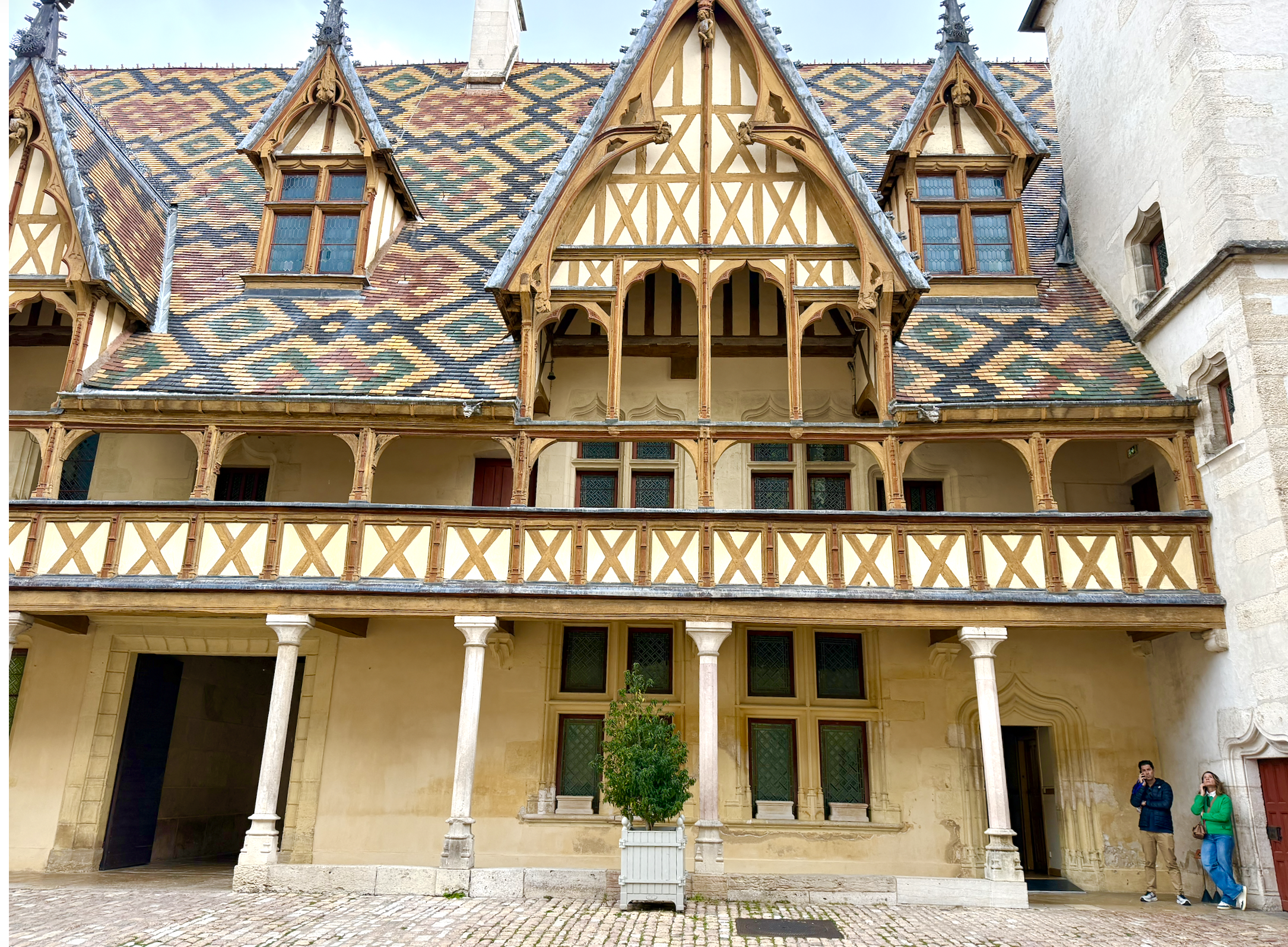
This thriving town of roughly 20,000 inhabitants is anchored by one of the most remarkable buildings in all of France: the Hôtel-Dieu, or “Hospital of God,” now a museum, which dates to 1443. During the Middle Ages, the concept of a hospice for the poor, the sick, and the disadvantaged was established across parts of Europe, typically financed and operated by the Church. In Beaune, however, it was Nicolas Rolin — Chancellor of Burgundy — and his wife Guigone de Salins who founded and funded the institution. The museum is extraordinarily well-preserved, and its iconic polychrome glazed tile roof leaves a lasting impression on every visitor. The Hospice de Beaune still commands reverence today as the home of the renowned November charity wine auction — a three-day affair culminating in the sale of 799 barrels of Burgundy’s finest wines.
Wandering Beaune’s cobblestoned streets, allow yourself to drift into the cave of Joseph Drouhin for a tasting of their Gevrey-Chambertin and a tour of their atmospheric underground cellars. It is a fabulous introduction to one of Burgundy’s most celebrated négociant houses. Stop at the fromagerie of Alain Hess, Maître Fromager, for a proper education in the region’s extraordinary cheeses. And linger over lunch at the Brasserie Le Carnot — a warm, reliable table with a lovely Burgundian spirit.
Now, about the cheese. Because in Burgundy, cheese deserves its own paragraph.
If you have an hour and a half to spare, drive to the village of Époisses. The cheese that bears its name was introduced to me by the great Jacques Pépin, who called it his favorite — and I have never forgotten either the lesson or the taste. Époisses is a pungent, unpasteurized cow’s milk cheese, aged four to eight weeks and hand-washed no fewer than three times with a mixture of water, salt, and marc de Bourgogne (the local brandy). It is this washing that coaxes the rind to its signature russet-gold color. At its peak, the interior is as yielding as custard. The Burgundian monks are credited with perfecting the process in the 11th century — and one cannot help but marvel that between cataloguing the terroir and tending the vines, they somehow also found time to give the world such a superlative fromage. Napoleon reportedly adored it. Brillat-Savarin crowned it “Le Roi des Fromages” — the King of Cheeses — and the title has never been seriously challenged. Slow Food maintains a presence in Époisses to this day, recognizing the cheese as part of France’s living culinary heritage. (In the United States, Époisses is available, though by regulation it must be made with pasteurized milk — good, but not quite the revelation you will experience here.)
As for where to sleep: Beaune itself, as I mentioned, offers relatively few hotel options within the town center. The true discoveries lie in the surrounding countryside, making it one of my favorites.